Waypost Plan a pilot

A call for help that doesn't need a phone.

Waypost puts a solar-powered help button every 200 yards along your trail. One press reaches your ranger station by radio, with the exact post, even where there is no cell signal.

The trail is where phones stop working and people get hurt.

A twisted ankle, a fall, chest pain, a lost child. On a paved street, someone calls 911. A mile into the woods, the phone shows no bars, the battery is low, or the walker never brought one.

The usual answer is a solar blue-light tower. Those run about $11,500 to $12,700 each at resellers, and every tower still needs cell signal or a clear line of sight. So parks buy one or two for the parking lot, and the trail itself stays dark.

Waypost is built for the trail itself: small posts, close together, that relay for each other.

What happens when someone presses the button

The system does not stop at "sent." It keeps escalating until a named person answers, and it tells the walker when that happens.

  1. Lift the guard, hold for two seconds

    The guard and the hold stop accidental presses. The ring around the button blinks amber: the post is sending.

  2. The alert hops post to post

    No cell signal on the trail is needed. Repeater posts pass the signed message along by long-range radio to a gateway at either end of the trail.

  3. The station alarm sounds and phones ring

    The wall map flashes the post: number, trail name, nearest vehicle access. The on-duty ranger gets a text and a voice call with a map link. The ring turns slow-blinking green: received.

  4. A person acknowledges, the ring goes steady green

    One tap at the station, a reply to the text, or pressing 1 on the call. The walker sees steady green and hears three beeps: a person has the call and help is coming.

  5. Nobody answered? The next person is paged

    The next name on the call list and the manager are both paged.

  6. Still nobody? 911 is called with the post's location

    By a person or a contracted monitoring center, in the way your county 911 center agrees to. The location comes from the post's surveyed coordinates, never from the caller.

Dana, Post 23, and ninety seconds

One call for help, followed from the button to the ranger and back.

It looks like a trail marker, because it is one

Baldwin Design Works has built park and trail signage for more than 30 years, including recycled-plastic help-locator posts already standing on greenways. Waypost puts a radio, a battery and a button inside that same kind of post, in your park's own marker design.

  1. Solar panel and antenna on top. The battery is sized for five sunless days. The antenna sits as high as the post allows.
  2. Number plate. Post number and trail name. Callers, staff and responders all say the same thing: "Post 23, River Loop."
  3. Guarded button with a light ring. A 22 mm stainless vandal-resistant button under a flip-up guard.
  4. Plain instructions. Including the line that matters most: if you can call 911, call 911 first.
  5. Sealed electronics. Radio, battery, temperature and tamper sensors in an IP67 box. A post that is knocked over or opened reports it.

What the ring tells the walker
23 River Loop Need help? Lift guard. Hold 2 seconds. If you can call 911, call 911 first. 1 2 3 4 5
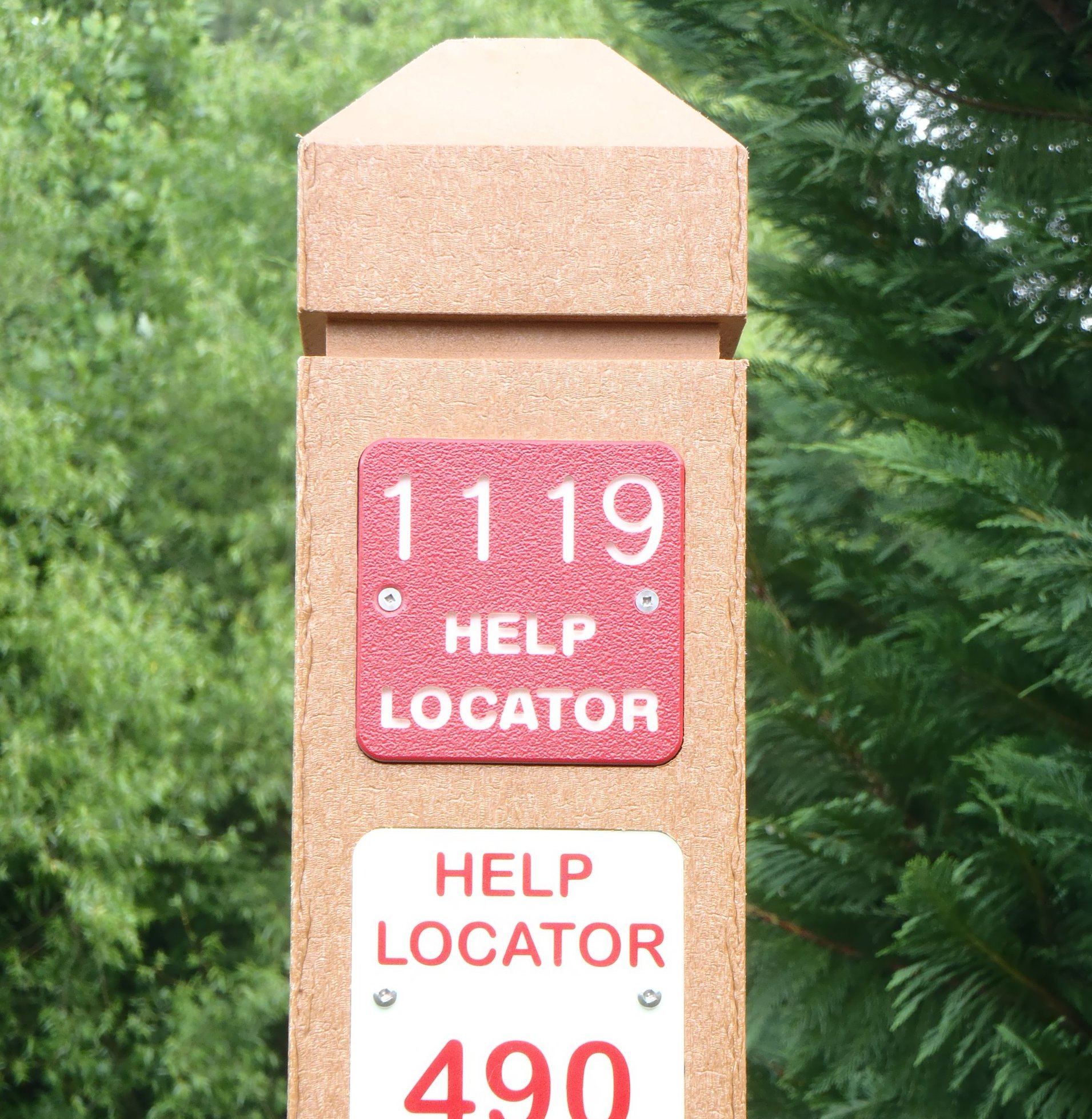
A tan recycled-plastic post with a pyramid cap and a red plate reading 1119 Help Locator, standing in front of trees.
A Baldwin help-locator post in service: recycled plastic, with locator plates for 911 dispatch. Waypost adds the button and the radio.
In
0
Out
0
On trail
0

This is everything the counter sees.

At closing time, know if anyone is still out there

A counter over every entrance reports people in and people out, live, on the same radio network as the posts. The station shows who is still on the trail, with an honest margin: "3, likely 1 to 5."

  • It counts people, not faces. The sensor is a 32 by 24 grid of heat readings looking straight down. It cannot see a face or read a shirt. Frames never leave the box and are never stored.
  • Groups count as people. Each head is its own warm spot, so a family of four counts as four. Two people passing in opposite directions count as one in and one out.
  • Dogs don't. A dog reads long, low and narrow, and passes under the waist-high confirming beam.
  • A sweep when it matters. If the number is not zero at closing, the closing ranger is paged with the count by entrance and the time of the last entry.

Commercial trail counters are built for monthly statistics. They upload every six hours, or wait for someone to walk out and download them. That is too late to tell you who is on the trail tonight.

In the ranger hut, nobody has to be watching a screen

A wall map that shouts

A TV in the hut shows your trail map with every post on it. A press flashes that post, names it in plain words ("Ridge Loop, past the creek bridge") and sounds an alarm that stops only when someone acknowledges.

Phones ring, wherever staff are

A text and an automated voice call go to the on-duty ranger. Press 1 or reply to acknowledge. The first acknowledgement wins, and every one is logged.

It works with the internet down

A radio on the hut roof feeds the office computer directly. Alerts show, alarms sound and acknowledgements reach the post with no internet at all. A second gateway at the far trailhead reaches the cloud over cellular.

Rangers test from the trail

A card-sized radio on the belt pairs with a phone app. A ranger can put one post into test mode, press the real button, and see "Post 23 passed, 4.1 s round trip," all without cell signal. Nobody is paged.

It tells you when it's broken

No safety system is 100 percent. So Waypost is designed around two rules: no single failure stops an alert from getting out, and every failure is reported within minutes, not discovered during an emergency.

What failsHow it's caughtThe office knows within
A repeater postIt checks in every 5 minutes. Two missed check-ins raise a "post offline" alert.About 10 minutes
A button postIt checks in every 15 minutes. Two missed check-ins raise the alert.About 30 minutes
A post down to one radio routeRepeaters report which neighbors they hear. The station counts routes for every post.The next check-in
Button wiring, light, battery or radioEvery post tests itself each morning around 6:00 and answers a challenge from the station.About 6:30 AM
The button's mechanical plungerStaff press every button on a regular walk. Overdue posts are flagged.The next walk test
A gateway or its cell linkGateways check in every minute. The other gateway carries the trail.About 3 minutes
The cloud service itselfAn outside monitor checks it every minute. Gateways can text the call list directly.1 to 2 minutes
  • Two routes from every post. Each post hears at least two repeaters, with a gateway at each end of the trail. Take one offline in the map at the top of this page and press again.
  • Messages can't be faked. Every press is signed with a key unique to that post, and replays are rejected. So are acknowledgements: the green light can't be spoofed.
  • Accidents and pranks are handled. A guard and a two-second hold to send. A separate eight-second hold cancels, and a cancelled alert still gets a welfare check.

Where Waypost fits, and where it doesn't

WaypostSolar blue-light call tower
Signal needed on the trailNone. Posts relay for each other by radio; only the gateways need a connection.Cell signal or line of sight at every tower
Spacing that's affordableA post about every 200 yards, so help is within about 100 yardsAbout $11,500 to $12,700 per tower at resellers, so usually one or two per park
If one unit diesNeighbors route around it and the office is toldThat point is dark
Live in and out countsYes, on the same networkNo
Two-way voiceNo. The ring light confirms a person answered.Yes
Blue strobe, AED cabinetNoAvailable on some models

A voice tower is still the right tool at a trailhead with power and cell signal. Waypost covers the miles after it.

Start with one section of trail

Radio range under summer leaves and battery life in a cloudy winter week are things nobody can promise on paper. So every Waypost install starts as a 60 to 90 day pilot on your own trail, with pass marks agreed up front.

What goes in

  • 6 to 8 posts, including one spur
  • 1 entrance counter
  • 1 gateway and the station display

What it has to prove

  • Every post keeps two radio routes in full leaf
  • Batteries hold through a cloudy week
  • Counts within 5% of a hand tally
  • Zero missed test presses

Who builds it. Baldwin Design Works designs and fabricates the posts: more than 30 years of park and trail signage, with eco-friendly recycled plastic available. Chuck Giddens builds the electronics, the radio network and the station software.

Ask about a pilot

Tell us about your trail. We'll reply with what a pilot would look like there.

Rather talk? Call Baldwin Design Works at 404.518.7688.

Questions park staff ask first

Does the button call 911?

Not by itself. A press pages your on-duty staff first. If nobody acknowledges within five minutes, 911 is called with the post's location by a person or a contracted monitoring center, in a form agreed with your county 911 center before go-live. Every post carries a sign: if you can call 911, call 911 first. The button supplements a phone; it does not replace one.

Who responds to a press?

Whoever you decide: your staff, a park ranger, or the county, with a call list and escalation times you set. Agreeing who responds during open hours and after hours is the first step of a pilot.

What about kids pressing it for fun?

The flip-up guard and two-second hold stop most accidents. Someone who pressed by mistake can cancel with a separate eight-second hold, and the station sees "cancelled by walker" rather than nothing. Each post keeps a press history, so a post that attracts pranks is easy to spot.

Does it track visitors or their phones?

No. Waypost does not look for phones at all. The entrance counters see heat as a 32 by 24 grid, keep only running totals, and store no images.

What keeps it running off-grid?

Each post has its own small solar panel and battery, sized to run five or more days without sun, and reports its battery and charging at every check-in. A post that stops charging raises a maintenance ticket before it goes dark.

Can it match the markers we already have?

Yes. Baldwin builds the electronics into your park's marker design: post or flush mount, your colors, your logo, recycled plastic if you want it.